Why Every Developer Should Learn Prompt Engineering (Even If It's Not Their Job)
Why prompt engineering is becoming one of the most valuable skills for developers in the AI era and how better prompting leads to better engineering.
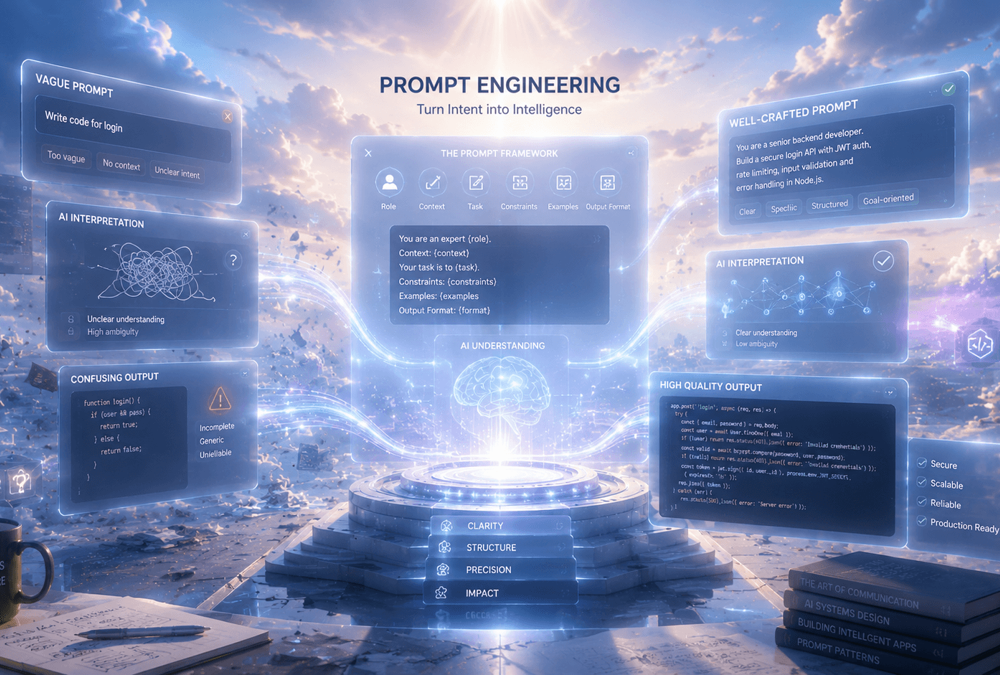
Two developers use the same AI coding assistant.
One ships features twice as fast.
The other spends hours fixing hallucinated code.
The difference usually isn’t the model.
It’s the prompt.
You’ve probably seen the job listings:
“Prompt Engineer - $150K+”
And maybe your first reaction was:
“That’s just talking to ChatGPT. How is that even a real engineering skill?”
Fair reaction.
But here’s what most developers are starting to realize in 2026:
Prompting casually is not a skill.
Systematically directing AI systems to produce reliable, production-quality outputs absolutely is.
And whether you’re a backend engineer, frontend developer, DevOps specialist, mobile engineer, or data scientist, this is quickly becoming one of the most valuable technical skills you can develop.
Not because AI will replace developers.
But because developers who understand AI collaboration will outperform those who don’t.
The Numbers Are Getting Hard to Ignore
The AI shift isn’t hypothetical anymore.
- Gartner projects that more than 80% of enterprises will have deployed generative AI-enabled applications in production by 2026, up from less than 5% in 2023.
- Research from Gartner, Deloitte, and McKinsey consistently shows that 70-80% of AI projects fail to reach production, and the leading causes aren’t the models themselves, but poor data quality, unclear business objectives, and lack of governance.
- According to PwC’s 2025 Global AI Jobs Barometer, which analyzed close to a billion job ads across six continents, workers with AI skills earn a 56% wage premium over colleagues in the same role without those skills. Just one year earlier, that premium was 25%. It more than doubled in twelve months.
And perhaps the most important insight:
Most AI workflows don’t fail because the model is weak.
They fail because the instructions are terrible.
That gap between weak prompting and effective prompting is becoming a real competitive advantage.
What Prompt Engineering Actually Is
Let’s remove the buzzwords for a second.
Prompt engineering is simply:
Designing structured instructions that help AI systems produce useful, reliable outputs consistently.
It’s less about “AI magic” and more about:
- communication
- precision
- context management
- system thinking
Good prompting reduces ambiguity.
And reducing ambiguity is what makes AI systems dramatically more reliable.
That’s why two developers using the same tool can get completely different results.

Weak Prompt
Write tests for this function.Strong Prompt
You are a senior QA engineer.

Write unit tests for the following Python function using pytest.

Requirements:
- Cover happy paths
- Cover edge cases
- Cover invalid inputs
- Include parameterized tests where useful

Return only executable test code with no explanation.
The second prompt gives you something you can actually merge into a PR.
The first gives you cleanup work.
Why Most Developers Get Mediocre AI Results
Most developers aren’t bad at using AI.
They’re just giving incomplete instructions.
Common mistakes:
- vague requests
- no project context
- missing constraints
- unclear output formats
- asking multiple things at once
- dumping huge code blocks without guidance
AI models are extremely sensitive to context quality.
Bad input leads to mediocre output.
And that’s why two developers using the same tool can get wildly different results.
Most developers are already using tools like:
- GitHub Copilot
- Cursor
- Claude
- ChatGPT
- Windsurf
- Codex
multiple times every day.
The issue is that most developers only use about 30-40% of these tools’ actual potential.
They:
- ask generic questions
- provide poor context
- fail to define constraints
- don’t structure workflows
The result?
More hallucinations.
More debugging.
More frustration.
Learning prompt engineering isn’t about becoming an “AI specialist.”
It’s about extracting significantly more value from tools you’re already paying for.

Structured Prompting Reduces Errors Significantly
One of the biggest misconceptions is:
“AI outputs are unreliable anyway.”
In reality, structured prompting can reduce output errors enormously.
Why?
Because ambiguity is one of the biggest causes of hallucinations.
The clearer your instructions:
- the fewer assumptions the model makes
- the more deterministic outputs become
- the easier results are to validate
Prompting well isn’t just about better outputs.
It’s about reducing operational friction.
Prompt Engineering Makes You a Better Developer
This is the part nobody talks about enough.
Writing strong prompts forces you to:
- define problems precisely
- think about edge cases
- communicate constraints clearly
- structure inputs and outputs
- reason systematically
In other words:
Prompt engineering trains the exact same thinking patterns that senior engineers rely on daily.
That’s why developers who become good at prompting often improve at:
- debugging
- architecture design
- technical communication
- documentation
- requirements analysis
It isn’t separate from software engineering.
It’s becoming part of it.
A Simple Prompt Framework That Actually Works
A surprisingly effective structure is:
ROLE → TASK → CONTEXT → CONSTRAINTS → OUTPUT FORMATExample:
You are a senior backend engineer.

Task:
Optimize this PostgreSQL query.

Context:
This query runs inside a high-traffic payment service.

Constraints:
- Preserve correctness
- Avoid schema changes
- Prioritize read performance

Output:
Return only optimized SQL and a short explanation.
This single framework improves output quality dramatically.
Same Developer, Different Prompting
| Task | Weak Prompting | Strong Prompting |
|---|---|---|
| Debugging | Generic suggestions | Root-cause analysis |
| Test generation | Basic tests | Production-ready coverage |
| Documentation | Verbose fluff | Structured technical docs |
| Refactoring | Breaks codebase | Context-aware improvements |
| Architecture help | Generic advice | Real tradeoff analysis |
The productivity difference compounds fast.
Real-World Developer Use Cases
You don’t need to build LLM products to benefit from this skill.
Here’s where prompt engineering already matters in everyday development work.
1. Debugging Production Issues
Instead of:
Why is this failing?Good developers now provide:
- expected behavior
- actual behavior
- logs
- attempted fixes
- constraints
- environment details
The quality jump is massive.
2. Test Generation
Structured prompting can generate:
- edge cases
- mocks
- fixtures
- integration tests
- performance tests
far faster than manual boilerplate creation.
3. Documentation
AI-generated documentation becomes genuinely useful when prompts specify:
- audience
- tone
- formatting
- assumptions
- technical depth
Otherwise, it produces generic nonsense.
4. Architecture Brainstorming
Walking AI through:
- constraints
- tradeoffs
- scaling concerns
- security requirements
- performance expectations
produces dramatically better architectural recommendations.

The Future of Software Is Becoming Conversational
Traditional software interfaces aren’t disappearing.
But the interface layer is changing.
Developers are increasingly interacting with systems through:
- natural language
- AI agents
- autonomous workflows
- conversational tooling
The next generation of software will not only be graphical.
It will also include conversational layers built on top of traditional workflows and tooling.
And developers who understand how to design and communicate in those environments will build better products faster.
A Real AI-Assisted Workflow
A senior developer debugging a production issue today might:
- Ask AI to summarize logs
- Generate possible hypotheses
- Explain suspicious stack traces
- Generate regression tests
- Suggest patches
- Draft incident documentation
- Create rollout checklists
That’s not replacing engineering.
That’s accelerating engineering.
Why Prompt Engineering Improves Your Career Growth
Technical skills matter.
But in 2026, companies increasingly reward engineers who can amplify the productivity of the entire team.
Developers with AI skills are:
- more likely to be promoted
- more likely to lead automation initiatives
- trusted more with architecture and decision-making
- more visible during sprint demos and technical reviews
A developer who understands prompt engineering becomes:
- A Problem Solver — they unblock problems faster, even in unfamiliar stacks or domains.
- A Multiplier — they help entire teams move faster, not just themselves.
- A Bridge — they translate product requirements into AI-assisted workflows.
- A Strategist — they understand when AI should be used and when it should not.
Managers notice this.
Because modern engineering teams are no longer judged only by how much code they write.
They’re judged by:
- delivery speed
- clarity
- adaptability
- problem-solving efficiency
- ability to leverage tools effectively
Prompt engineering strengthens all of those skills.
And perhaps most importantly:
Prompt engineering is not about writing beautiful prose.
It’s about creating clarity.
When you can bring clarity to ambiguous problems, your value as an engineer increases automatically.
How to Learn Prompt Engineering
You do not need a certification.
You do not need to become a full-time “Prompt Engineer.”
You simply need consistent, intentional practice.
1. Learn Basic Prompt Structures
Understand frameworks like:
- ROLE → TASK → CONTEXT → CONSTRAINTS → OUTPUT
- few-shot prompting
- chain-of-thought prompting
- iterative refinement
These alone dramatically improve AI outputs.
2. Use AI During Real Work
The fastest learning happens during actual development work.
Use AI for:
- debugging
- writing tests
- documentation
- code reviews
- SQL optimization
- architecture brainstorming
You’ll quickly notice which instructions improve results.
3. Analyze Failed Outputs
Most improvement comes from studying bad responses.
Ask:
- Was the prompt vague?
- Did it lack context?
- Were constraints missing?
- Was the output format unclear?
Prompt engineering improves rapidly through iteration.
4. Build Reusable Prompt Systems
Instead of writing random prompts repeatedly:
- save good prompts
- create reusable templates
- organize workflows
- refine instructions over time
Treat prompts like engineering assets.
5. Study Advanced Workflows
Once comfortable, explore:
- AI agents
- RAG systems
- multi-step workflows
- prompt chaining
- autonomous developer tooling
This is where AI stops being a chatbot and starts becoming infrastructure.

Final Thought
The best developers of the next decade probably won’t be the ones who memorize the most syntax.
They’ll be the ones who can:
- think clearly
- communicate precisely
- collaborate effectively with intelligent systems
- direct powerful tools toward meaningful outcomes
That is why prompt engineering matters.
Not because it replaces software engineering.
But because it enhances it.
The developers who learn AI collaboration early will:
- build faster
- learn faster
- debug faster
- adapt faster
- create larger impact with the same amount of effort
Right now, this skill is still early enough to create real differentiation.
A few years from now, it will likely become a standard expectation across engineering teams.
The window to learn it early is still open.
Start now.
Found this useful? Follow for more writing on AI, developer productivity, modern engineering workflows, and building in public.
Share this insight
Join the conversation and spark new ideas.